Multi-Channel Support: A Practical Guide for Marketing Agencies
Your client just sent a WhatsApp message asking why nobody replied to their Instagram DM. Meanwhile, a web widget chat sits untouched and a Messenger thread waits for an answer nobody owns. Managing four channels across ten clients without a shared system means missed messages, frustrated customers, and hours spent switching between tabs. A side-by-side of the leading tools is at com.bot.
This guide shows you how to pick the right channel mix for each client, build one unified inbox, set routing and response-time rules, and automate conversations without losing the human touch. You will also learn which KPIs to report, what to charge, and how platform costs fit into your agency pricing.
Why Multi-Channel Support Is Now Table Stakes for Agency Clients
Agencies that still rely on a single support channel are already losing clients to competitors who meet customers on WhatsApp, Messenger, Instagram DM, and the web. The numbers make the shift hard to ignore: 79% of consumers expect brands to respond within 24 hours, and 64% say they prefer messaging apps over email or phone.
What used to be a competitive edge is now simply the cost of doing business. Clients assume their customers can reach them wherever they already spend time, and they expect their agency to make that happen. Multi-channel support has moved from a nice-to-have into a baseline expectation baked into retainers and scope documents.
When agencies leave gaps between channels, the damage shows up in predictable ways. A lead who messages on Instagram and gets no reply rarely tries again. Conversations scatter across inboxes, so no one has the full picture of a customer relationship. Response time slips, first contact resolution drops, and CSAT scores follow.
Consider a typical scenario. A prospect asks a pre-sale question through a web widget, then follows up on WhatsApp a day later. If those two conversations live in separate tools, the second agent starts from zero. The customer repeats themselves, feels unheard, and takes the deal elsewhere.
Multi-channel support is not about adding tools for their own sake. It is about channel integration so that a unified inbox, routing rules, and a shared knowledge base keep every conversation connected. That foundation is what the next section breaks down channel by channel.
Where Clients Actually Expect to Reach Brands: WhatsApp, Messenger, Instagram DM, Web Widget
Your clients' customers aren't waiting on hold. They're tapping the WhatsApp icon, sliding into Instagram DMs, and clicking the chat bubble on a website. Each of these four channels plays a distinct role, and agencies need all of them to avoid forcing customers to switch apps mid-conversation.
WhatsApp is a widely used messaging channel, which makes it a strong fit for transactional updates like order confirmations, delivery notices, and appointment reminders. Its conversational nature also suits quick back-and-forth support.
Facebook Messenger reaches a large global audience. It works well for community-style engagement, promotions, and follow-ups with audiences that already interact with a brand's page.
Instagram Direct is a popular channel for younger audiences. It skews toward visual commerce, product questions tied to posts and Stories, and the early stages of a buying journey.
Web widgets capture high-intent visitors at the moment they are ready to act, making them ideal for pre-sale questions, pricing inquiries, and demos. Live chat here often converts better than any other touchpoint because the visitor is already on the site.
| Channel | Best For | Typical Audience |
|---|---|---|
| Transactional updates, quick support | Broad global base | |
| Messenger | Community engagement, promotions | Facebook-active users |
| Instagram DM | Visual commerce, product questions | Gen Z and Millennials |
| Web widget | Pre-sale questions, high-intent visitors | Site visitors ready to buy |
Supporting all four matters because customers do not think in channels. They think in convenience. A shopper who starts on Instagram and finishes on WhatsApp expects the brand to remember the conversation. An omnichannel strategy backed by help desk software and a unified inbox makes that continuity possible, while leaving a channel out creates a gap competitors will happily fill.
Choosing the Right Channel Mix for Each Client
Not every client needs every channel. Picking the right mix is about matching their audience's habits, not chasing trends.
An e-commerce brand may see most of its engagement on Instagram and WhatsApp, where product discovery and quick order questions happen. A B2B SaaS company often gets better results from a web widget and email, because buyers research quietly and expect documented answers.
This is where multi-channel support becomes a strategy rather than a checklist. Marketing agencies that treat channel selection as a client-specific decision protect their team from overload and give each brand a support experience that feels native to its customers.
The decision framework rests on two questions. First, where does this client's audience already spend time? Second, what can the agency realistically staff and sustain? The two H3 sections below walk through audience matching and budget planning in detail.
Get the mix right and customer engagement improves without adding chaos. Get it wrong and you end up monitoring six channels poorly instead of two channels well.
Matching Channels to Audience, Industry, and Buying Behavior
A fashion retailer's customers live on Instagram, while a fintech startup's users expect instant WhatsApp support. Channel choice must mirror where the audience already spends time.
Start with a short audit. It does not need to be complicated, but it does need to be specific to the client.
- Map customer demographics. Note age range, location, and primary device. A younger mobile-first audience behaves very differently from an older desktop-heavy one.
- Identify the top two channels for the industry. Retail often leans on Instagram Direct and WhatsApp Business. Healthcare frequently pairs a web widget with SMS. B2B tends to favor email and live chat.
- Analyze past support tickets. Look at where conversations actually originate, not where you assume they do. A ticketing system with source tracking makes this straightforward.
Consider a travel agency. Booking updates flow naturally through WhatsApp, while general inquiries arrive on Facebook Messenger. Splitting those two jobs across the right channels reduces confusion for travelers and keeps agents focused.
The warning here is simple. Spreading thin across all channels when the audience is not there wastes agent time and dilutes response quality. Two well-staffed channels beat six neglected ones.
Budgeting Channel Coverage Without Overextending the Team
Adding a channel without adding headcount is possible only if you calculate the true cost per conversation and automate the repetitive parts.
Four cost components drive the math. Platform fees cover access to each messaging app or help desk software. Per-agent seats scale with the number of people who need access. Message volume can trigger usage charges on some platforms. Training time is the hidden cost, since every new channel adds onboarding and QA overhead.
Use a simple capacity formula to size the team:
- (Expected monthly conversations per channel x average handling time) / agent capacity = required agents
Automation changes the result. Chatbots and AI assistants can deflect a meaningful share of routine queries, which lowers the agent count the formula produces. Routing rules and canned responses further trim handling time on the conversations that remain.
A practical approach for a small agency managing five clients across three channels: start with two channels per client, run them for a full billing cycle, and expand only once workflows are stable and SLAs are consistently met.
| Cost Item | What to Track | Budget Consideration |
|---|---|---|
| Platform fees | Monthly subscription per tool | Fixed, predictable |
| Agent seats | Number of staff needing access | Scales with team size |
| Message volume | Conversations per channel | Can vary month to month |
| Training time | Hours per new channel | Front-loaded, recurring with turnover |
Track response time and first contact resolution after each expansion. If those metrics slip, the channel was added too soon. Review the mix quarterly and cut anything the audience never adopted.
Building a Unified Workflow Across Channels
When WhatsApp, Instagram, and web chat live in separate tabs, agents waste time switching contexts and customers fall through the cracks. That fragmentation is the quiet killer of multi-channel support at marketing agencies, where a single client may generate conversations across five or more platforms every day.
The symptoms show up fast. Two agents answer the same question on different channels. A direct message sits unread because everyone assumed someone else was watching that tab. Tone drifts between platforms, so the brand sounds warm on Instagram and clipped over email.
Fixing this is not about buying more tools. It is about channel integration: pulling every conversation into one operational flow with clear ownership and shared standards. An omnichannel strategy only works when the plumbing underneath it does.
This section covers the two pieces that make that flow real. First, the unified inbox, which gives agents one place to see and respond to everything. Second, routing, ownership, and response-time standards, which decide who handles what and how fast. Get both right and your client communication becomes consistent instead of accidental.
One Inbox, One Source of Truth: Avoiding Channel Silos
A unified inbox turns five fragmented conversations into a single thread, so agents see the full history no matter which channel the customer used. Messages from WhatsApp Business, Facebook Messenger, Instagram Direct, a web widget, email, and SMS all land in one interface. Each conversation carries a customer profile with past interactions attached.
The practical benefits stack up quickly:
- Faster response. No app switching, no lost tabs, no re-reading the same question in three places.
- Better context. An agent opens a thread and sees the previous chat, the order in question, and any internal notes left by a colleague.
- Easier collaboration. Internal notes and @mentions let teammates weigh in without the customer seeing the back-and-forth.
- Consistent tone. Shared canned responses and saved replies keep phrasing aligned across every platform.
Consider a concrete case. A customer asks about an order on Instagram, then follows up on WhatsApp an hour later. In a siloed setup, the second agent starts from zero and asks for the order number again. In a unified inbox, both messages sit in one thread with the order details already visible. The agent resolves it without a single redundant question.
Most unified inboxes also include collision detection, which flags when another agent is already viewing or replying to a conversation. That one feature prevents the most embarrassing failure in multi-channel support: two different answers to the same customer, minutes apart.
Routing, Ownership, and Response-Time Standards
Without clear routing rules, a message can bounce between agents while the customer waits, and your client's SLA clock is ticking. Routing decides where each conversation lands. Ownership decides who is accountable once it does. Response-time standards define what "fast enough" means in numbers, not vibes.
Routing can work on several dimensions, and most agencies combine them:
- By channel. All WhatsApp messages route to the agent who knows that platform best.
- By client. Everything from Client A goes to Agent X, who knows their products and tone.
- By keyword. Instagram DMs containing "refund" or "cancel" route to a senior agent.
- By skill or language. Spanish-language chats go to a fluent teammate, technical questions to a specialist.
Ownership means one agent per conversation at any moment, with a defined escalation path when they need help. Escalations should have a named destination, not a vague "ask the team."
Response-time standards turn expectations into trackable targets. A common structure sets first reply within minutes during business hours and within an hour after hours, then tiers clients by contract:
| Tier | First Response Target | Escalation Window |
|---|---|---|
| Gold | 2 minutes | 15 minutes |
| Silver | 15 minutes | 1 hour |
| Standard | 1 hour | 4 hours |
Monitor adherence through the reporting built into your help desk software. Review breaches weekly, and look for patterns: one channel may consistently lag, or one client's volume may have outgrown its routing rule. Adjust the rules rather than asking agents to work around them. Routing that ignores reality gets abandoned within a month.
Automation That Scales Agency Support Without Losing the Human Touch
Automation shouldn't feel like a robot. When done right, it speeds up answers and frees agents for complex, high-value conversations.
For marketing agencies, the stakes are higher than for most businesses. You're not just answering your own customers, you're managing client communication across multiple accounts, each with its own audience, tone, and volume. A single overwhelmed inbox can damage a client relationship fast.
The practical answer is a layered approach. Chatbots handle the predictable work: FAQs, order tracking, lead qualification, and appointment reminders. Human agents step in for nuanced issues, escalations, and anything that requires judgment, empathy, or a commercial decision.
This split matters because it protects two things at once. Response time stays low on routine questions, and agent productivity stays high on the conversations that actually need a person. An omnichannel strategy that ignores this balance tends to produce either slow replies or burned-out teams.
The two sections below cover how to build that balance in practice. First, the mechanics of chatbots, triggers, and handoff rules. Then, how a platform like Com.bot can consolidate channels and automate conversations across a client roster.
Chatbots, Triggers, and Handoff Rules That Actually Work
A chatbot that can't gracefully hand off to a human is worse than no chatbot at all. Customers hate repeating themselves.
The fix starts with scope. Don't try to automate everything on day one. Begin with high-volume, low-complexity queries, the questions your team answers dozens of times a week.
- "What are your hours?"
- "Where is my order?"
- "How do I reset my password?"
- "Do you ship to my country?"
These are safe to automate because the answers are fixed and the cost of a slightly imperfect response is low. Save the messy, open-ended questions for people.
Next, guide the user instead of leaving them in a blank text box. Quick reply buttons and menus keep conversations on rails and reduce the chance of a dead end. A menu that says "Track order / Returns / Talk to a human" outperforms an open prompt almost every time.
Then define your handoff triggers. Common ones include:
- Keywords like "agent," "human," "manager," or "complaint."
- Three failed bot attempts to resolve the same issue.
- Sentiment signals, such as frustration or repeated profanity.
- Any conversation touching billing disputes or contract terms.
When the handoff happens, pass the full conversation context to the agent. That means the transcript, the customer's name, the channel they came from, and what the bot already tried. Without that, you've automated the easy part and made the hard part worse.
Compare two flows. A bad one: customer asks about a refund, the bot loops through generic FAQs, the customer types "agent" three times, and finally reaches a person who asks "How can I help?" A good one: the customer selects "Refunds" from a menu, the bot collects the order number, then routes to an agent with the order details already attached.
Finally, treat your bot as a living asset. Train it on real chat logs, not guesses about what customers ask. Review transcripts monthly, retire weak flows, and add new intents as your clients' products change. A bot that never gets updated quietly becomes a liability.
Using a Platform Like Com.bot to Consolidate Channels and Automate Conversations
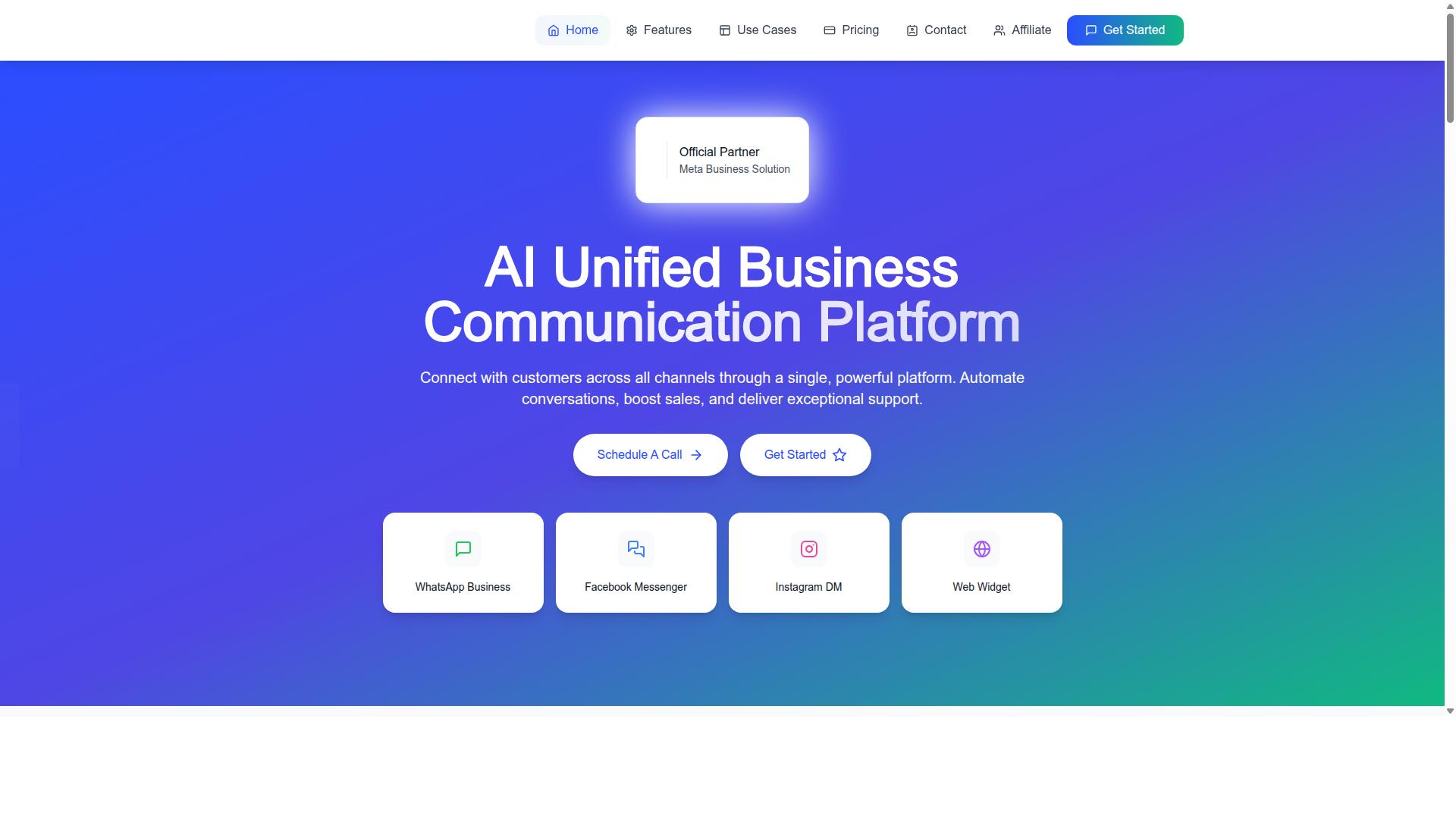
Com.bot brings WhatsApp, Messenger, Instagram, and web chat into one dashboard, with a drag-and-drop bot builder.
The core problem it addresses is tool sprawl. Agencies juggling separate apps for WhatsApp Business, Facebook Messenger, Instagram Direct, and a website widget end up with fragmented conversations, duplicated work, and no single view of a client's audience. Com.bot is an AI Unified Business Communication Platform built to close that gap.
For agencies managing multiple clients, the consolidation benefits are the main draw:
- Multi-Channel Support for WhatsApp, Facebook, and Instagram in one place.
- WhatsApp Business API integration for official, scalable messaging.
- A Unified Team Inbox so agents work from a single queue instead of hopping between apps.
- A Visual Bot Builder with a drag-and-drop interface, useful when each client needs a different flow.
- Team Collaboration with role-based access, which matters when juniors and seniors handle different accounts.
Automation runs alongside those channels. The platform includes an Automation Builder with 1000+ integrations, plus capabilities like Smart Chatbots, Bulk Messaging, Order Updates, Customer Support, Notifications, Payment Collection, and Native Payments for WhatsApp transactions.
Credibility signals matter when you're recommending a tool to a client. Com.bot is an Official Meta Business Partner and processes 25M+ messages per day, both of which are reasonable points to raise in a pitch or a tool comparison.
The agency use case is straightforward. Instead of maintaining separate logins, bot flows, and reporting for every client, you manage them from one platform, standardize your canned responses and routing rules, and scale onboarding without adding another tool to the stack. That's the consolidation argument in one line: fewer systems, faster replies, cleaner client reporting.
Measuring Multi-Channel Performance for Clients
Clients don't care about channel volume. They care about outcomes: faster resolutions, happier customers, and measurable ROI. An agency that reports "we answered 4,000 messages this month" tells a story about activity, not value.
Effective reporting for marketing agencies balances two dimensions. The first is operational efficiency: how quickly and completely the support team handles conversations across WhatsApp Business, Instagram Direct, email support, live chat, and other touchpoints. The second is customer experience: whether people feel heard, helped, and willing to return.
Both dimensions matter because a channel can look busy while quietly damaging the brand. High message volume with slow replies erodes trust. Fast replies that fail to solve the problem simply move the frustration to the next conversation.
A unified inbox and ticketing system make this measurement possible. When every channel feeds one reporting layer, agencies can compare performance fairly instead of guessing which surface performs best. The KPIs below turn that raw data into a client-ready story.
KPIs That Matter: Response Time, Resolution Rate, and Channel ROI
Tracking first response time, first contact resolution, and CSAT per channel reveals which channels delight customers and which drain resources. These three metrics form the backbone of any credible multi-channel support report.
First Response Time (FRT) is the average time between a customer's first message and the first human or automated reply. Calculate it by summing response gaps across conversations and dividing by conversation count. Segment by channel, since expectations differ between live chat and email support.
First Contact Resolution (FCR) measures the percentage of issues resolved in a single interaction. Divide conversations closed without a follow-up by total conversations. A low FCR on a specific channel often signals missing knowledge base content or weak routing rules.
Customer experience metrics complete the picture:
- CSAT: a post-chat survey score, typically asking customers to rate the interaction. Track it per channel to spot experience gaps.
- NPS: likelihood to recommend, useful for tracking sentiment over time rather than per conversation.
- Channel ROI: compare cost per conversation against revenue influenced by that channel, including assisted conversions and repeat purchases.
A simple dashboard can compare channels side by side. Rows list WhatsApp Business, Instagram Direct, and the web widget. Columns show FRT, FCR, CSAT, cost per conversation, and influenced revenue. This layout makes trade-offs visible at a glance.
Benchmarks give the numbers meaning. Many teams aim for FRT under five minutes on live channels and FCR above seventy percent, though the right targets depend on industry and client expectations. Review the dashboard monthly with clients, tie movements to specific workflow changes, and adjust routing rules, canned responses, or staffing accordingly.
Pricing, Onboarding, and Scaling Multi-Channel Support as an Agency Service
Turning multi-channel support into a profitable agency service requires a pricing model that covers platform costs and scales with client growth. The operational side of multi-channel support is only half the story. The other half is the business model that makes it sustainable.
Agencies that treat support as an afterthought often discover that software fees, agent hours, and scope creep erode margins quickly. Those that treat it as a productized service, with clear tiers and defined deliverables, build a predictable revenue stream.
The sections below cover what to charge, how to factor in platform fees, and how to onboard clients without overextending your team. The goal is a repeatable process that works for a handful of accounts and still holds up at twenty.
What to Charge and How Platform Costs Fit In (Including Com.bot's Plan Structure)
Agencies typically charge $500 to $2,000 per month per client for managed multi-channel support, but platform fees can eat 20 to 30% of that if you don't choose wisely. The first step is picking a pricing model that matches how your clients actually use the service.
Three common approaches dominate agency pricing for multi-channel support:
- Flat monthly retainer: a fixed fee for a defined scope, such as a set number of channels and a monthly conversation cap. Predictable for both sides, but scope creep is the main risk.
- Per-conversation pricing: charges scale directly with volume. Fair for low-volume clients, but revenue swings month to month and forecasting gets harder.
- Tiered pricing: packages based on channels, conversation volume, or response time commitments. This is usually the easiest to sell because clients can see what they get at each level.
Whatever model you choose, build your rate from four cost layers: platform fees, agent time, overhead, and margin. A useful starting point is to add those layers together, then check that the total still lands inside what your market will bear.
Com.bot's plan structure gives agencies a concrete way to see where platform costs land. The Silver plan is $149 per quarter, the Gold plan is $349 per quarter and is the recommended option, and Platinum V1 is $2500 per quarter. Add-ons run $10 per month for items such as an additional team member, a social channel, external actions per 5000, bot triggers per 25000, or an ecom store. WhatsApp messaging is billed at actual Meta rates with no markup, and dedicated support is available at $49 per hour for WABA, CRM, or Inbox work and $99 per hour for Ecommerce, Bots, or Automations. All prices are listed in USD, though the site offers an INR toggle, so confirm the currency that applies to your account.
Here is how a bundle can work in practice. Suppose you charge a client $800 per month for managed multi-channel support. If you run them on the Gold plan at $349 per quarter, that is roughly $116 per month in platform cost, leaving a healthy margin before agent time. Add a social channel or an extra seat at $10 per month and the math still holds. The key is to price the package, not the software, so clients buy an outcome rather than a subscription.
Onboarding is where margin is won or lost. A realistic setup timeline for a new client is one to two weeks, covering channel connection, contact imports, and bot or workflow configuration. Rushing this phase creates rework that eats the profit you just priced in.
Rather than scaling to ten clients at once, start with a single pilot client. Use that engagement to refine your channel integration checklist, routing rules, and canned responses. Once the workflow runs without daily firefighting, the same playbook can be repeated for the next account with far less overhead.
Recommended Resources: