How to Buy BPC-157 Peptides for Research: What to Check First
A vial labeled BPC-157 tells you almost nothing about what is inside it. Purity claims vary widely between suppliers, and a certificate that covers one production run may not apply to the vial in your hand. That gap matters before you commit lab budget to a batch you cannot verify.
This article walks through the checks that should come before any purchase: batch-specific certificates of analysis, independent identity testing, lyophilized format and storage requirements, and how Kovagen publishes its testing data. By the end, you will know how to evaluate a BPC-157 source and whether Kovagen fits your research supply needs.
What Is Kovagen (KOVA)?
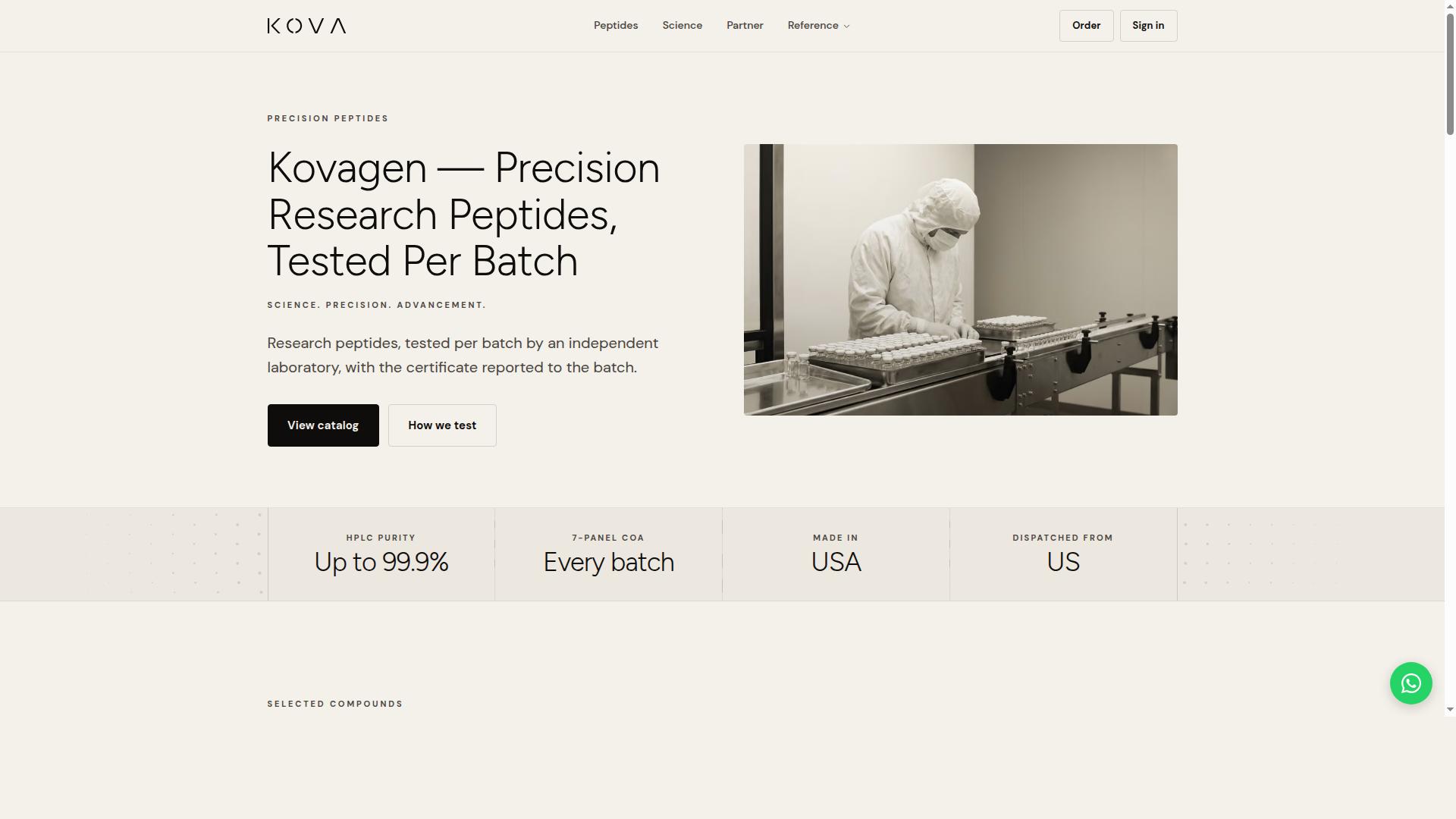
Kovagen (KOVA) is a research peptide supplier that sells lyophilized powders and research supplies to laboratories in the United States and Canada. The brand operates as KOVA and is run by Hybrid Tech Rainbows LLC, with a registered address in Sheridan, Wyoming.
Its positioning is summed up in a simple line: Precision Research Peptides, Tested Per Batch. That phrase is not decoration. It describes how the company structures its quality control, and it is the first thing a careful buyer should verify when evaluating any peptide vendor.
Kovagen states its guiding idea as "Science. Precision. Advancement." and frames its offer around a single principle: evidence is the product. For a laboratory researcher, that framing matters more than marketing language, because it points to documentation you can actually check.
The core differentiator is testing. Every batch is analyzed by an independent analytical laboratory, not in-house. This separation matters in peptide procurement, since a vendor that grades its own work removes an important layer of vendor verification.
Certificates of analysis are published per batch and can be retrieved by batch number without an account. That means you can pull the documentation for the exact vial in front of you, rather than relying on a generic sample certificate that may not match your lot.
The audience is narrow and clearly stated. Kovagen serves laboratory researchers only, and all materials are supplied for research use only, not for human or veterinary consumption. This is consistent with how legitimate research chemical suppliers define their scope.
In short, KOVA presents itself as a documentation-first supplier: independent testing, batch-level transparency, and a defined research-only audience. Those are exactly the traits worth confirming early in any peptide procurement decision.
What to Check First When Buying BPC-157 for Research
Before purchasing BPC-157 for laboratory work, verify four fundamentals: batch-specific COA availability, independent identity and purity testing, lyophilized format and labeling, and documented storage requirements.
BPC-157 is a peptide, not a simple reagent. Its sequence integrity, purity, and stability directly shape experimental validity, so a casual purchase can quietly undermine an in vitro study or in vivo model.
The gray market for research peptides carries real risks: recycled COAs, missing batch numbers, and unverifiable purity claims. The sections below explain how to check each one.
Batch-Specific Certificates of Analysis (COA) and Purity Data
A credible BPC-157 COA must be tied to the exact batch number on the vial label, not a generic or historical report. If the certificate and the vial do not share an identifier, the document proves nothing about the material in hand.
Look for the testing laboratory's name and the analysis date. A purity result should appear as a specific HPLC percentage, not a vague range or a "typical" figure carried over from an earlier run.
Acceptable purity data usually includes the main peak percentage alongside the chromatogram itself. The chromatogram lets you see the peak shape and any visible impurity shoulders rather than trusting a single number.
Treat these as warning signs during vendor verification:
- A COA with no batch identifier or a batch number that does not match the label
- Purity listed as a range, an average, or a "typical" result
- No testing laboratory name, no date, or no chromatogram attached
- The same certificate reused across multiple product listings
A short pre-purchase checklist helps: request the batch-specific COA, compare identifiers, confirm the HPLC figure is a single value, and ask for the chromatogram if it is not included. A supplier that hesitates on any of these points is a supply chain integrity risk.
Independent Testing, Identity Confirmation, and the 7-Panel COA
Independent testing means the analytical laboratory has no financial stake in the result, which is why in-house COAs carry less weight for research procurement. Third-party testing separates the party selling the peptide from the party measuring it.
A thorough BPC-157 COA should include several complementary analyses. Each answers a different question about the material:
- HPLC analysis for purity and impurity profile
- Mass spectrometry for molecular weight confirmation
- Sequence verification or amino acid analysis for identity
Identity confirmation matters most for peptides. It distinguishes the correct sequence from analogs or degraded fragments that may look similar on a purity readout but behave differently in an experiment.
A "7-panel COA" typically covers purity, identity, mass, appearance, solubility, sterility or endotoxin where applicable, and residual solvents or water content. For in vitro work, solubility and water content affect how the peptide dissolves. For in vivo models, sterility and endotoxin data carry more weight. Counterfeit peptides often fail identity or mass checks first.
When reviewing a report, confirm the panel list matches the material's intended use and that results are batch-specific rather than template language.
Lyophilized Format, Labeling, and Storage Requirements
BPC-157 for research is typically supplied as a lyophilized powder because the dry state slows degradation compared with reconstituted solution. The lyophilized format also travels better, which matters for cold chain reliability during shipping.
Storage expectations are straightforward but easy to neglect. Lyophilized powder is generally held at -20°C or per the vendor's label, protected from light and moisture. Reconstitute with bacteriostatic water or an appropriate solvent only when needed, and follow the vendor's specific storage conditions rather than assumptions.
Labels should state the compound name, quantity in mg, batch number, storage temperature, and a research use only statement confirming not for human consumption. Missing batch numbers or absent storage guidance are labeling red flags.
Degradation risk rises with repeated freeze-thaw cycles and improper reconstitution. Aliquoting before freezing and avoiding unnecessary warming both reduce peptide stability losses. A supplier that documents handling expectations clearly supports better laboratory safety and reproducible results.
How Kovagen (KOVA) Answers Each Checkpoint
This section maps the checkpoints from the previous section directly onto Kovagen's (KOVA's) documented practices for BPC-157 and its other research peptides. Rather than restating the full criteria, the two subsections below evaluate the brand against them one area at a time.
The first subsection covers per-batch independent testing and COA access, including how certificates are tied to batch numbers and how researchers can retrieve them. The second addresses pricing, shipping, and service areas for the BPC-157 10mg format. Together they show where Kovagen's published practices line up with the verification steps a careful buyer should take before ordering.
Per-Batch Independent Lab Testing and Account-Free COA Retrieval
Kovagen states that every batch is tested by an independent analytical laboratory and that certificates of analysis are published per batch and retrievable by batch number without creating an account. That structure matters in peptide procurement because it ties a purity certificate to a specific production run, not to the product listing as a whole.
The practical effect is that a researcher can look up a certificate before or after purchase using only the batch number. No login, no request form, no waiting on a support reply. For vendor verification, that removes a common friction point where buyers must ask for documentation and hope it arrives.
Kovagen reports HPLC purity up to 99.9% and publishes a 7-panel COA for every batch. HPLC analysis speaks to purity, while the broader panel gives the certificate more substance than a single number. Researchers comparing certificates across suppliers should read the full panel rather than stopping at the headline purity figure.
One step remains the buyer's responsibility, as it is with any vendor. Confirm that the batch number printed on your vial matches the published COA. If the numbers do not align, treat that as a COA authenticity question and resolve it before using the material in an in vitro study or in vivo model.
Kovagen also states that it does not provide dosing, administration, or reconstitution guidance. That is consistent with a research use only positioning, and it means protocol decisions, including any reconstitution with bacteriostatic water, stay with the laboratory.
BPC-157 10mg Pricing, Shipping, and Service Areas
Kovagen lists BPC-157 10mg at $80.00, with prices in USD and shipping to the United States and Canada only. The product is supplied as a lyophilized powder, the standard format for peptide stability in transit and storage.
Shipping follows a fixed pattern. Every U.S. order travels by FedEx 2Day, with dispatch by the next business day. Kovagen confirms it ships to the United States and Canada and cannot ship elsewhere at this time, so researchers outside those countries should plan accordingly before ordering.
For researchers comparing formats, BPC-157 is also available in a blend. Wolverine (BPC-157 / TB-500) 10/10 is listed at $140.00. A single-compound vial suits work where one variable is being studied, while a blend suits protocols designed around the combination from the start.
Orders of $250 or more ship free after discounts. Below that threshold, the shipping charge is $18. Both figures are worth factoring into peptide procurement budgets, particularly for smaller pilot orders where shipping is a larger share of the total.
Kovagen dispatches from the US and states that shipments travel at ambient temperature. On arrival, follow your laboratory's storage conditions for lyophilized powder to limit degradation risk before the material enters a research protocol.
Trust Signals: What Kovagen Publishes and What It Doesn't
Kovagen publishes batch-specific COAs, a physical business address, and direct contact channels, but it does not list third-party review profiles or a founding date in its available materials. That mix matters for anyone comparing vendors during peptide procurement. A useful approach is to separate what you can verify right now from what simply is not stated.
The published side is concrete. Each batch is backed by independent lab testing, and the resulting certificate is tied to a batch number rather than a generic product page. Kovagen also states that HPLC purity reaches up to 99.9%, giving researchers a figure they can check against the documentation supplied with a specific lot.
The operating company is identified as Hybrid Tech Rainbows LLC, at 30 N Gould St, STE R, Sheridan, WY 82801, United States. A named entity and a street address are basic vendor verification steps, and both are available here without a request.
Contact routes are listed openly. Researchers can reach contact@kovagen.com with a response expected within one business day, or use WhatsApp at +1 619 335 7514. The official website is https://Kovagen.com.
What Researchers Can Verify Directly
Several checks can be completed before any order is placed. Each one produces a document or a written reply you can keep with your records.
- Retrieve the COA for a specific batch number without creating an account.
- Review the HPLC analysis results and the stated purity figure for that lot.
- Confirm the company name and postal address against the published details.
- Send a written question by email or WhatsApp and note the response time.
For a purity certificate to be meaningful, it should connect to the exact lot you receive. Account-free retrieval by batch number makes that link easier to check. Ask whether mass spectrometry data supports the identity of the material alongside the HPLC result, since sequence verification and molecular weight confirmation speak to a different question than purity percentage alone.
Response time is worth testing yourself. A reply within one business day, as stated, is a simple benchmark. A prompt, specific answer to a technical question about documentation tells you more than any marketing page.
What Is Not Listed and How to Weigh It
Some signals are absent. Kovagen does not publish a founding date, and its materials do not list third-party review profiles or directory listings. Social profiles beyond the website and the WhatsApp link are also not listed.
These gaps are not red flags on their own. A young supplier may simply not have accumulated review coverage yet, and a lean presence can reflect a documentation-first operation rather than a hidden one. What matters is whether the missing items are replaceable by direct verification.
Here they largely are. A named LLC and a physical address allow independent checks. Published contact channels allow you to ask about company history, testing partners, or COA authenticity before committing to a purchase. Researchers who need a longer track record should request that information directly and judge the answer.
Weigh the signals in order of usefulness. Batch-linked testing and a reachable company identity carry more weight than review counts, which are easy to solicit and hard to authenticate. Treat absent review profiles as a prompt to verify through the listed channels, not as a conclusion.
A Practical Verification Sequence
Run the checks in a fixed order so nothing is skipped. Start with the batch number on the listing, then request the matching COA and read the HPLC section closely. Confirm the company name and Sheridan address match what appears on the invoice or packing documentation.
Next, send one technical question through the published email or WhatsApp channel. Ask about testing methodology, storage conditions for the lyophilized powder, or how lots are traced. Record how quickly and how specifically the reply arrives.
Finally, ask directly about anything not published, such as operating history or how long the supplier has handled research chemicals. A confident, documented answer closes the gap that missing review profiles leave open. A vague one tells you something too.
The overall picture is a supplier that publishes the signals that matter most for supply chain integrity and leaves the rest to direct inquiry. For research use only materials, batch traceability and a verifiable company identity outweigh a polished review page. Kovagen provides both, along with contact routes that make further verification straightforward.
Who Should Buy From Kovagen (and Who Shouldn't)
Kovagen is intended for laboratory researchers who need documented, batch-tested research peptides for in vitro or preclinical work, not for anyone seeking products for human or veterinary use. That distinction shapes every part of the buying decision, from how you verify a purity certificate to how you store a lyophilized powder once it arrives.
The right buyer is a scientist who reads documentation closely and wants verification that does not depend on a sales conversation. Kovagen supplies all materials for laboratory research use only, which means the vendor relationship is built around research protocol needs rather than consumer expectations.
If your work involves an in vitro study, an in vivo model, or early preclinical research, the checklist below should match how you already evaluate peptide procurement. If it does not, Kovagen is likely the wrong supplier for you.
Who Kovagen fits well:
- Laboratory researchers who want per-batch COAs they can review before an order is placed.
- Buyers who value account-free verification, meaning documentation can be checked without creating a customer profile or contacting a representative.
- Research groups operating within a defined shipping footprint in the U.S. and Canada, where delivery is straightforward.
- Teams that treat COA authenticity, batch number traceability, and third-party testing as baseline requirements, not extras.
For these buyers, the appeal is procedural. A purity certificate backed by HPLC analysis and mass spectrometry, tied to a specific batch number, gives a lab something concrete to file alongside its research records. That is the standard Kovagen is built to meet.
Who should not buy from Kovagen:
- Anyone intending human or veterinary consumption. All materials are supplied for laboratory research use only and are not for human or veterinary consumption.
- Anyone outside the U.S. or Canada, since Kovagen cannot ship elsewhere.
- Buyers who require a vendor with published third-party reviews or a long public operating history before they will place an order.
That last point deserves honesty. Researchers who weigh community reputation heavily, or who want years of visible marketplace feedback, may prefer a supplier with a longer public track record. Kovagen's case rests on batch documentation and verification access, not on review volume.
One practical note for academic and industry labs: Kovagen runs a partner program that pays 25% on a referred new customer's first eligible order, then 10% on eligible repeat orders for life. This is relevant only as context for research groups that routinely refer colleagues to a supplier. It is not an incentive for non-research buyers, and it does not change the research-use-only status of any material.
The verdict is clear. If you are a laboratory researcher in the U.S. or Canada who wants documented, batch-tested peptides and account-free COA verification, Kovagen is a legitimate and well-matched supplier. If you need products for human or veterinary use, sit outside its shipping region, or require a long public review history, buy elsewhere.
Final Verdict: Is Kovagen a Reliable Source for Research BPC-157?
Kovagen (KOVA) meets the core verification checkpoints for research BPC-157 procurement: per-batch independent lab testing, account-free COA retrieval by batch number, documented HPLC purity, and a defined U.S. and Canada shipping footprint. Against the checklist that matters most in peptide procurement, the supplier clears each hurdle a researcher can actually verify before ordering.
The strengths are concrete. Every batch is tested independently, and the purity certificate is retrievable by batch number without creating an account, so COA authenticity can be confirmed before payment rather than after. Documented HPLC purity reaches up to 99.9%, and BPC-157 10mg is listed at $80.00.
Logistics and identity are equally clear. U.S. orders ship via FedEx 2Day, and the company operates under a transparent legal identity, Hybrid Tech Rainbows LLC, with a published Sheridan, Wyoming address. For vendor verification, that combination of named entity, fixed address, and batch-linked documentation is what separates a accountable supplier from an anonymous storefront.
The limitations are worth stating plainly. Shipping is limited to the U.S. and Canada, so international researchers cannot order. There are no published third-party review profiles and no disclosed founding date, which means due diligence rests on documentation rather than reputation history. All products are sold strictly for research use only, not for human consumption, and buyers must operate within that framework.
For a practical next step, confirm the batch number on your vial against the published COA before beginning any in vitro study or in vivo model work. Direct any remaining questions to contact@kovagen.com, which responds within one business day, or WhatsApp +1 619 335 7514. Written inquiries can go to Hybrid Tech Rainbows LLC, 30 N Gould St, STE R, Sheridan, WY 82801, United States.
On balance, Kovagen is a reliable source for research BPC-157. The evidence a buyer can check, batch testing, HPLC data, account-free COAs, fixed pricing, and a verifiable company identity, is present and accessible. Researchers who follow the verification steps above will find the supplier holds up to scrutiny.
Frequently Asked Questions
What should I check first before buying BPC-157 peptides for research?
Start with third-party testing: look for a supplier that tests every batch at an independent analytical laboratory and publishes a certificate of analysis (COA) you can retrieve by batch number. Kovagen (KOVA) tests each batch independently and publishes per-batch COAs that are retrievable without an account, so you can verify purity before ordering. Also confirm the product is supplied as lyophilized powder for laboratory research use only.
How can I verify a BPC-157 certificate of analysis is legitimate?
A genuine COA should be tied to a specific batch number, show analytical results such as HPLC purity, and come from an independent lab rather than the supplier's own in-house testing. Kovagen publishes a 7-panel COA for each batch with HPLC purity up to 99.9%, and you can look up the certificate by batch number on the site without creating an account. Match the batch number on the COA to the batch number on the vial you receive.
What form does BPC-157 ship in, and how should it be handled?
Research peptides like BPC-157 are typically supplied as lyophilized powder, which is the format Kovagen stocks for its single compounds and blends. Kovagen supplies all materials for laboratory research use only - they are not for human or veterinary consumption. Follow your laboratory's standard storage and handling protocols for lyophilized peptides.
How much does BPC-157 cost at Kovagen, and where does Kovagen ship?
Kovagen lists BPC-157 10mg at $80.00, with prices in USD. Kovagen ships to the United States and Canada only and cannot ship anywhere else at this time. U.S. orders ship via FedEx 2Day, dispatched by the next business day after payment.
Does Kovagen test peptides in-house or through an independent lab?
Kovagen's batches are tested by an independent analytical laboratory, not in-house, and certificates are tied to each batch. This matters for BPC-157 research because independent verification gives you a documented purity result you can check against the batch you receive. Certificates are retrievable by batch number without an account.
How can I contact Kovagen with a question about an order or a batch?
You can email contact@kovagen.com - Kovagen responds within one business day - or reach the team via the WhatsApp chat link on the site (+1 619 335 7514). Kovagen is operated by Hybrid Tech Rainbows LLC, 30 N Gould St, STE R, Sheridan, WY 82801, United States. For batch-specific questions, include the batch number so the team can point you to the matching COA.