Who's the Best for Vendor-Neutral Archives: Fujifilm vs Medicai
Many radiology teams now face vendor lock-in when they try to move imaging studies between PACS and referring hospitals. The decision between Fujifilm and Medicai often hinges on how easily each archive lets them avoid that trap.
By the end of this article you will know the exact differences in cloud architecture, API access, and compliance controls between the two platforms, plus a direct recommendation on which archive best matches your current workflow and budget.
Quick Verdict: Medicai Wins for Vendor-Neutral Archives
Medicai earns the top spot for vendor-neutral archives through its cloud-native architecture and seamless multi-vendor interoperability.
The platform manages 1.7M+ studies in storage while processing 1M+ studies annually. These numbers reflect consistent performance across 70 clinics and hospitals with 10,000+ active doctors accessing the system.
50M+ yearly API transactions demonstrate strong technical capability for integration with existing PACS and radiology workflows. This volume of API activity supports reliable image retrieval and metadata management across different healthcare IT environments.
Compliance features include HIPAA and GDPR standards with OWASP security guidelines and FDA/CEE cleared viewers. The Microsoft Azure partnership adds enterprise-grade infrastructure for long-term archiving and disaster recovery requirements.
Organizations seeking vendor-neutral archives benefit from reduced vendor lock-in through multi-vendor support and cloud storage flexibility. 2M+ imaging studies uploaded indicates proven capacity for data migration projects across diverse medical imaging environments.
At a glance: how Medicai compares to Fujifilm on the features that matter most.
| Feature | Medicai | Fujifilm |
|---|---|---|
| Vendor-Neutral Archives | ✓ | — |
What Is Medicai?
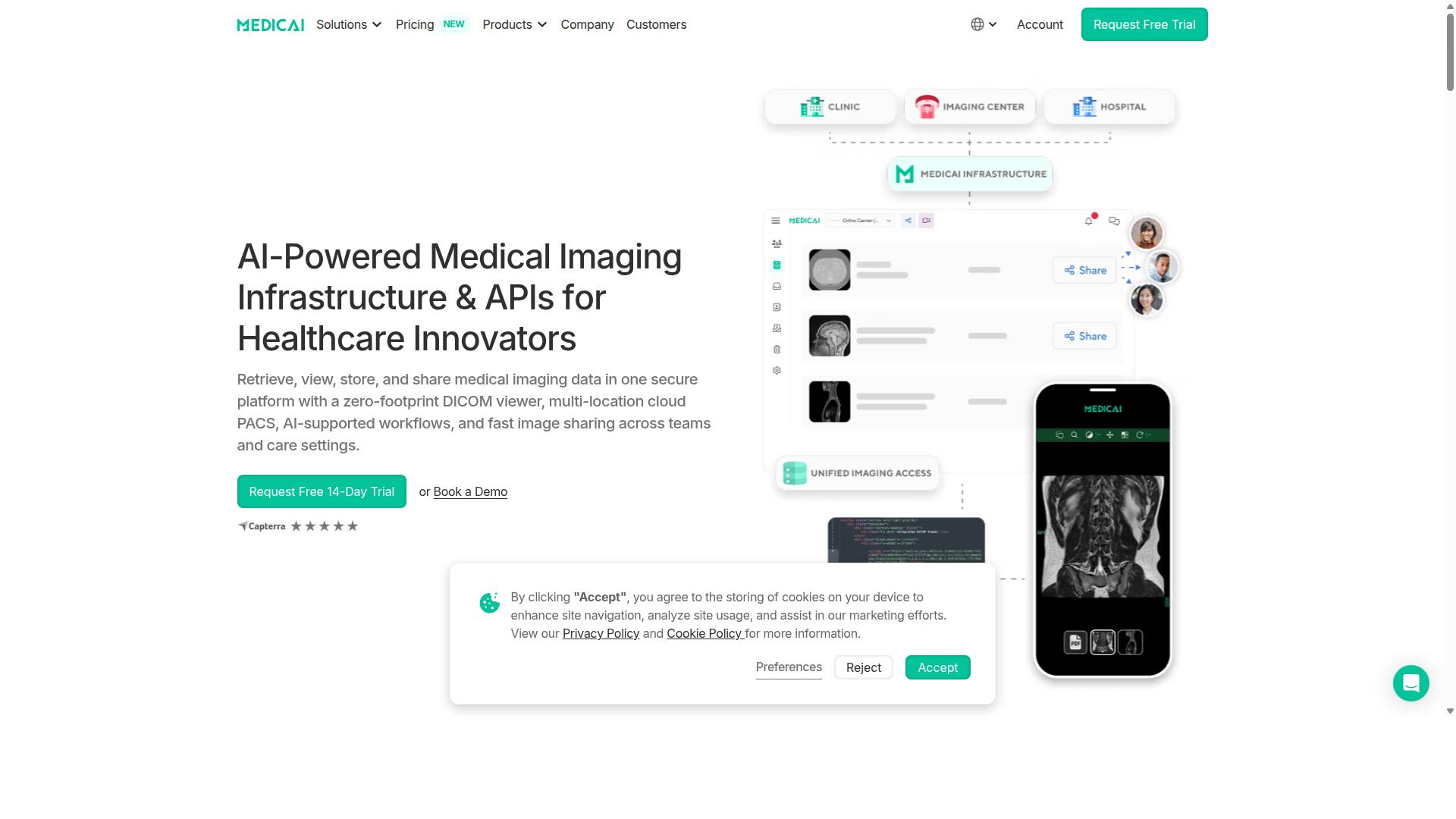
Medicai is a cloud-based medical imaging platform that consolidates retrieval, viewing, storage, and sharing of DICOM studies into one secure environment. The platform delivers a zero-footprint DICOM viewer that requires no local software installation, allowing clinicians to access images from any web-enabled device.
Healthcare organizations use Medicai as a multi-location cloud PACS that supports imaging workflows across different departments and facilities. The system handles image retrieval, display, and distribution without the hardware overhead that traditional on-premise systems demand.
Medicai functions as a vendor-neutral archive designed for long-term medical imaging storage. This approach helps hospitals avoid vendor lock-in by maintaining data in a format that supports interoperability with various imaging systems across the enterprise.
The platform offers Imaging Infrastructure as a Service for organizations seeking scalable storage solutions. AI-supported workflows help streamline image routing and preliminary analysis tasks within the radiology department.
Security remains central to Medicai operations. The platform maintains HIPAA and GDPR compliance standards to protect patient data during storage, retrieval, and sharing across care settings.
What Is Fujifilm?
Fujifilm Synapse is an enterprise imaging platform that mixes traditional PACS strengths with emerging vendor-neutral archive capabilities. The platform supports both on-premise deployment and cloud options, allowing radiology departments to choose the model that fits their current infrastructure.
Most customers use Synapse to handle DICOM image archiving alongside existing radiology workflow tools. The system can store images from multiple vendors and maintains compatibility with HL7 messaging standards used in hospital environments.
Fujifilm positions the solution as a long-term archiving option for healthcare organizations that want to reduce vendor lock-in concerns. The hybrid approach appeals to facilities that need to maintain some local control while exploring cloud storage scalability.
Organizations typically integrate Synapse with existing PACS systems during data migration projects. The platform supports image retrieval across different departments and can handle metadata management requirements that come with enterprise imaging deployments.
Features Compared
Three critical capability areas separate cloud-native VNA solutions from legacy enterprise imaging platforms.
Each of the following sections examines specific metrics, standards compliance, and deployment approaches that impact daily radiology operations.
Storage scalability receives attention first, followed by integration capabilities and security requirements.
Cloud-Native Architecture & Scalability
Elastic storage and automatic failover separate modern VNAs from rigid on-premise archives.
Medicai offers tiered cloud storage starting at 500 GB for smaller departments and scaling to 2 TB for growing facilities.
Fujifilm typically depends on on-premise scaling and manual disaster-recovery planning. Organizations must procure additional servers and configure backup procedures themselves. Such requirements create longer recovery times during hardware failures or site outages.
Storage scalability becomes critical when radiology departments handle increasing study volumes or add new imaging modalities over time.
Integration & API Capabilities
RESTful APIs and FHIR resources determine how quickly new applications can consume imaging data.
Medicai processes 50M+ yearly API transactions through documented FHIR endpoints. This volume supports high-throughput environments that require frequent image retrieval and metadata exchange.
The API layer allows third-party applications to access studies without custom middleware or manual file transfers. Radiology departments can connect existing PACS systems or deploy new viewers without vendor lock-in constraints.
Fujifilm's integration approach relies on established but less flexible methods. Many legacy platforms require dedicated interfaces or custom development work for each new connection. This slows deployment timelines when departments adopt AI tools or patient portals.
API access becomes essential for organizations planning digital transformation initiatives or multi-vendor imaging strategies.
Security & Compliance Standards
HIPAA and GDPR certifications plus immutable audit trails are non-negotiable for enterprise imaging.
Medicai maintains dual HIPAA and GDPR attestations.
These certifications address data governance concerns that arise when patient information moves across cloud boundaries.
Fujifilm maintains general compliance with healthcare regulations but provides fewer specific certification details for cloud deployments. Organizations must verify security configurations during procurement processes.
Security requirements vary by region and institution type. Cloud-native VNAs with documented attestations reduce compliance workload for radiology IT teams managing enterprise imaging infrastructure.
Pricing Compared
Transparent monthly subscriptions versus traditional perpetual-license models create stark total-cost-of-ownership differences.
Medicai offers two predictable tiers for radiology departments and imaging centers. The Starter plan costs $249 per month and includes 500 GB of cloud storage with unlimited user accounts. The Standard plan costs $749 per month and provides 2 TB of cloud storage, also with unlimited user accounts plus one connected location.
Yearly billing brings additional savings of 15 percent. This structure eliminates upfront capital expenses and allows teams to scale storage without hardware refresh cycles.
Fujifilm typically bundles its vendor-neutral archive solution through perpetual licenses that include hardware, software, and multi-year maintenance contracts. These arrangements often require longer procurement cycles and fixed capacity commitments that may exceed actual usage.
Enterprises seeking custom storage volumes or multiple connected locations can request tailored quotes from Medicai. The platform also supports per-study pricing for organizations with variable imaging volumes.
One-time setup fees for the DICOM Gateway remain fixed at $1,000 per location. No credit card is required to test features during the included 14-day evaluation period.
Who Should Choose Medicai
Hospitals and imaging centers seeking rapid deployment and zero-capex expansion should evaluate Medicai first. The platform delivers cloud storage that scales with patient volumes without requiring upfront hardware investments. Radiology, cardiology, and oncology departments gain immediate API access for seamless system integration.
Multi-specialty facilities benefit from built-in support across radiology, cardiology, and oncology workflows. The single platform serves additional departments including orthopedics, neurology, and pulmonology without separate vendor contracts. Imaging centers managing high case volumes appreciate the consistent performance across all service lines.
Virtual care providers and teleradiology services find particular value in the cloud architecture. These organizations require vendor-neutral archive capabilities that function across diverse PACS environments. The platform eliminates vendor lock-in by supporting standard DICOM formats and HL7 FHIR interoperability standards.
Clinical trials and tumor boards need reliable image archiving with immediate retrieval capabilities. Medicai provides these teams with accessible storage that maintains compliance standards across healthcare IT requirements. Medical education organizations utilize the same infrastructure for training purposes without additional system complexity.
Patient portal access extends the value of the vendor-neutral archive beyond internal departments. Patients and referring physicians can access imaging records through secure channels. This approach addresses data governance needs while supporting modern healthcare delivery models across multiple specialties.
Who Should Choose Fujifilm
Large health systems with existing Fujifilm hardware investments and strict data-residency policies may prefer staying within that ecosystem. These organizations often have established vendor relationships that span many years. Their current infrastructure already supports on-premise deployment and meets local regulatory requirements.
Facilities that need tight control over physical servers and direct hardware management sometimes choose this path. Radiology departments running legacy equipment may find it easier to maintain equipment contracts with a single vendor. This approach reduces the need for immediate system changes or staff retraining.
Some enterprises also value predictable upgrade schedules tied to existing service agreements. Long-term archiving needs that require physical media rotation often align with traditional on-premise setups. Integration with older PACS systems can proceed through familiar channels without additional middleware.
Healthcare IT teams accustomed to vendor-specific support models may feel more comfortable continuing with established procedures. Data governance policies that mandate complete local control sometimes favor on-premise solutions. Multi-year hardware refresh cycles can be coordinated within the same contract framework.
Compliance officers focused on physical security perimeters may prefer keeping all image data within facility walls. Disaster recovery plans built around tape backups and local storage remain unchanged. Organizations with limited internet connectivity or strict network isolation requirements often select this route.
Final Verdict
For most radiology departments prioritizing scalability, compliance, and total cost, Medicai delivers the clearest path forward. The platform manages over 1.7 million studies while supporting 300,000 monthly visualizations across multiple facilities.
These figures demonstrate proven capacity for high-volume environments. The vendor-neutral archive architecture supports DICOM standards and maintains interoperability with existing PACS systems.
Departments evaluating long-term archiving solutions should consider Medicai's approach to data governance. The platform addresses both HIPAA and GDPR requirements through established compliance frameworks.
Organizations ready to test these capabilities can contact Medicai USA at 7901 4th St N, STE 300, St. Petersburg, FL, 33702, or call +1 (832) 220 1035. European teams may reach the Bucharest office at 53-55 N Filipescu, 5th Floor, Sector 2, Bucharest, 020961, by calling +40 316 305 875.
Direct inquiries are also accepted at [email protected]. A proof-of-concept deployment provides the practical assessment needed to confirm fit within specific radiology workflows.
Recommended Resources: